Roamer Ecosystem
A personal identity layer for the open web
Roamer is a personal digital sovereignty system.
It does not try to create one more login account, one more social graph, or one more centralized identity provider. Instead, Roamer gives a person a portable cryptographic root they control, then lets different tools attach useful proofs to that root: credentials, privacy protections, reputation signals, recovery relationships, avatars, and optional behavioral attestations.

The simple idea is:
Roamer helps you prove things about yourself when needed, hide unnecessary signals when not needed, and move between services without handing your identity to a platform.
The result is not another account system. It is a portable identity architecture where the person, not the platform, is the control point.
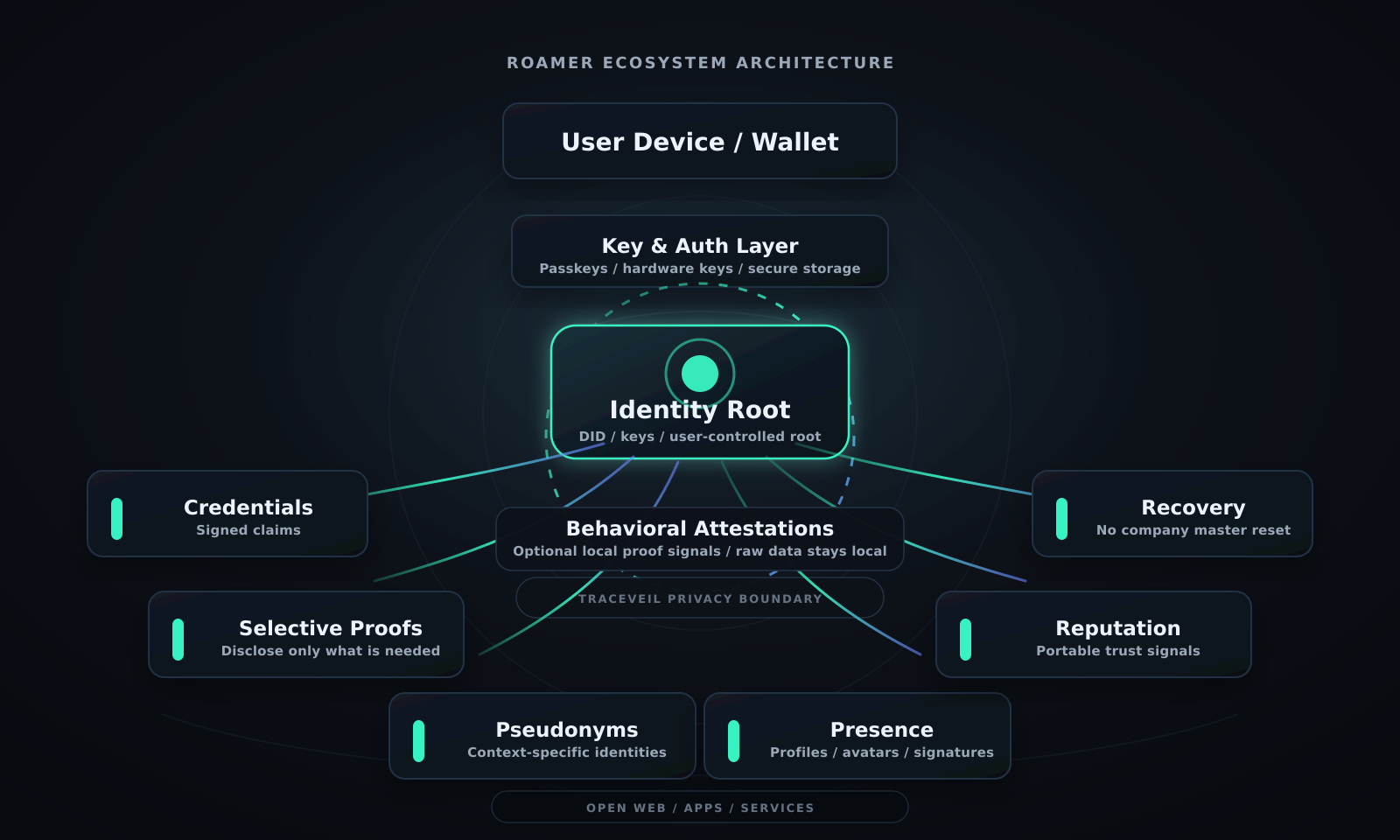
The ecosystem model
Roamer is designed as a set of interoperable layers. Each layer solves one part of the personal sovereignty problem, and each can evolve independently.
Identity Root
Everything starts with the individual.
The Identity Root is the foundation of Roamer. It gives the user a cryptographic anchor that can support credentials, proofs, pseudonyms, reputation, recovery, and digital presence without depending on one platform account.
This does not mean one identity everywhere.
It means one user-controlled root from which different identities, contexts, and proofs can be managed.
Key & Auth Layer
A sovereign identity system has to be usable.
The Key & Auth Layer connects the identity root to real-world authentication methods such as passkeys, hardware keys, secure device storage, or wallet-managed signing keys.
The goal is to make strong identity control practical without forcing users to manage raw cryptographic complexity.
Credentials Layer
Roamer should let people prove selected facts without exposing everything. A user might need to prove they are over a certain age, belong to a group, own a domain, completed a course, created a work, or received a trust signal from another party.
The Credentials Layer is where signed claims and selective presentations belong.
The principle is simple: prove what is necessary, reveal as little as possible.
Traceveil Privacy Layer
Traceveil is the first working component of the Roamer ecosystem. It belongs in the privacy layer.
Traceveil reduces passive browser tracking and fingerprinting by making selected browser signals less identifying and less reliable for cross-site correlation. It does not try to solve identity by itself. It solves one important part of the stack: making the browser less useful as an involuntary tracking device.
Roamer begins with privacy because identity without privacy becomes surveillance.
Behavioral Proof Layer
Some forms of trust may come from continuity, authorship, or behavior over time. But raw behavioral data is deeply sensitive.
The Behavioral Proof Layer is designed around a local-first principle: behavioral signals should stay on the user’s device wherever possible. If useful, local modules may produce signed attestations that prove continuity or authorship without exposing the underlying raw data.
Zero-knowledge proofs may become part of this later, but the first principle is simpler: do not export the person in order to prove the person.
Reputation Layer
Reputation should be portable, but not forced into one public score.
Today, reputation is trapped inside platforms: reviews, followers, work history, marketplace ratings, creator credibility, and community trust. Roamer treats reputation as something the individual should be able to carry, selectively disclose, and use across contexts.
Trust should follow the person when they choose.
It should not become a universal social credit system.
Avatar / Presence Layer
A person is not one flat profile.
Roamer supports contextual identity: professional, personal, creative, civic, anonymous, pseudonymous, and private modes of being online.
The Presence Layer is where profiles, avatars, signatures, authorship proofs, and public representations can live. Some identities may be persistent and reputable. Some may be temporary. Some should never be connected.
Pseudonymity is not deception. It is a legitimate form of privacy, safety, creativity, and freedom.
Recovery Layer
Identity must survive device loss, account loss, and platform failure.
The Recovery Layer explores ways to recover access without giving one company master control. This may include multi-device keys, trusted recovery contacts, threshold recovery, backup credentials, and key rotation.
A real sovereignty system must include exit, portability, and recovery.
The user must be able to leave.
l
Layer |
User Meaning |
Developer Meaning |
|---|---|---|
| Identity Root | “This is my portable identity anchor.” | A cryptographic identifier controlled by user-held keys, not by Roamer servers. |
| Key & Auth Layer | “I unlock identity with my device, passkey, or hardware key.” | WebAuthn/passkeys, Secure Enclave/TPM, hardware security keys, or wallet-managed signing keys. |
| Credentials Layer | “I can prove facts without exposing everything.” | Verifiable credentials, presentations, status/revocation, and selective disclosure where supported. |
| Traceveil Privacy Layer | “My browser leaks less about me.” | Fingerprint normalization, permission controls, tracker filtering, and privacy policy enforcement. |
| Behavioral Proof Layer | “I can prove continuity or authorship without showing raw behavior.” | Local behavioral models producing signed attestations; raw behavioral data stays local. |
| Reputation Layer | “Trust follows me without becoming a public social score.” | Portable attestations from counterparties, communities, services, or devices. |
| Avatar / Presence Layer | “I can appear differently in different spaces while still being verifiable.” | Pseudonymous profiles, avatars, metadata, service endpoints, and presentation policies. |
| Recovery Layer | “I can recover access without giving a company master control.” | Multi-device keys, recovery contacts, threshold shares, backup credentials, and key rotation policies. |

What Roamer is building toward
Roamer is building toward an internet where individuals can:
- move across platforms without being owned by them
- prove selected facts without exposing everything
- use different identities in different contexts
- reduce passive tracking and fingerprinting
- carry trust signals where it makes sense
- recover identity without depending on one company
- participate as humans without accepting mass surveillance as the price of trust
The internet does not need to choose between chaos and surveillance.
There is another path: user-controlled identity, structural privacy, selective proof, portable trust, and open systems.
That is the Roamer ecosystem.