
Roamer Roadmap
Roamer is being built in layers.
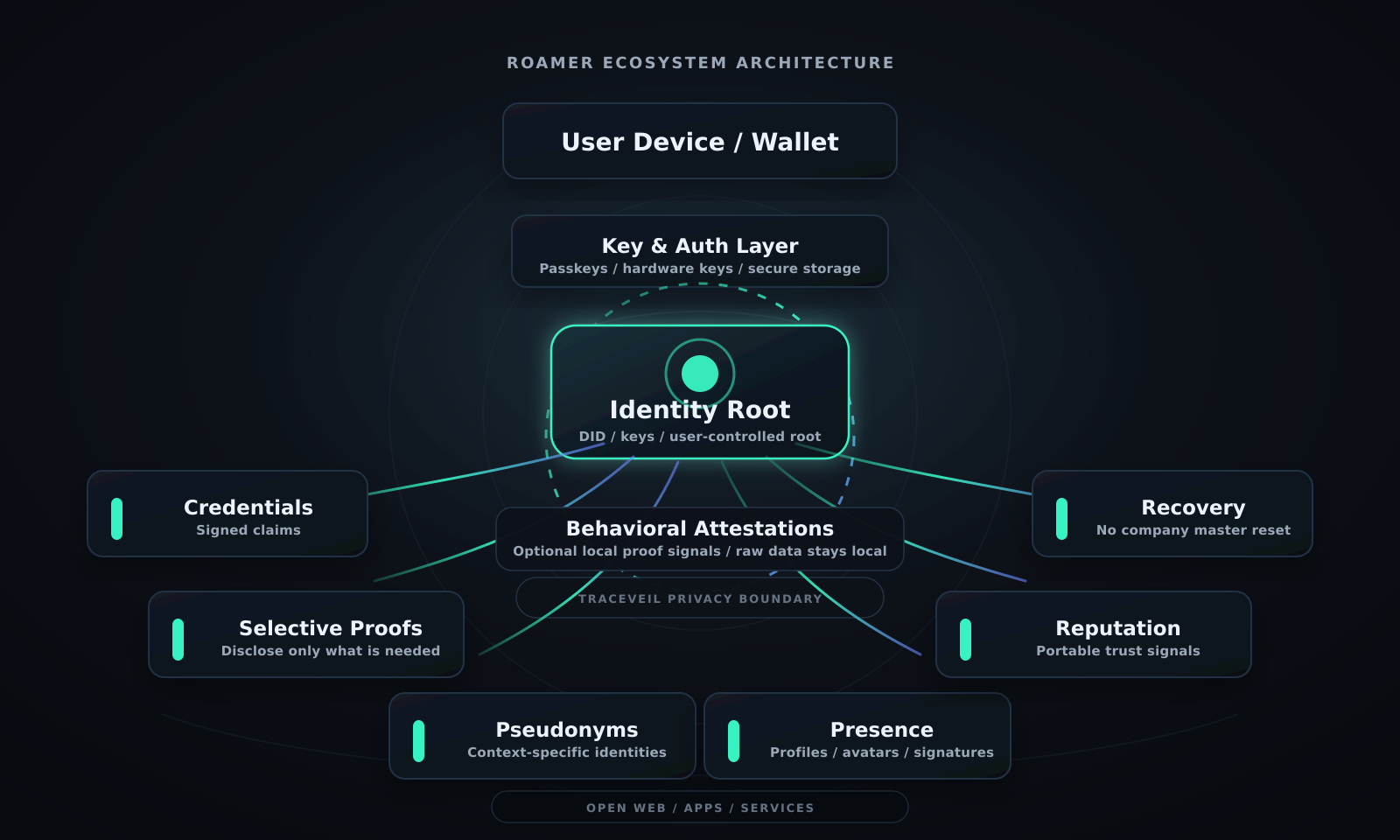
The goal is not to launch one giant identity platform, but to assemble a practical, open-source personal sovereignty stack step by step: privacy protection, cryptographic identity, selective proof, portable reputation, recovery, and public presence.
Stage |
Focus |
What It Means |
|---|---|---|
| Foundation | Public architecture, principles, and Traceveil | Define the philosophy, threat model, visual language, and first privacy component. |
| Identity Root | Local-first personal identity wallet | A user-controlled cryptographic root using passkeys or hardware-backed keys. |
| Pseudonym Layer | Contextual identities | Separate professional, personal, anonymous, creative, and public identities without forcing one flat profile. |
| Proof Layer | Verifiable credentials and selective disclosure | Let people prove specific facts without revealing unnecessary personal data. |
| Recovery Layer | Human-safe identity recovery | Recovery options that do not depend on one company, one email account, or one device. |
| Reputation Layer | Portable trust signals | Let useful reputation move with the person when they choose, instead of staying trapped in platforms. |
| Presence Layer | Profiles, avatars, signatures, authorship proofs | Public-facing identity surfaces controlled by the individual. |
| Developer Layer | SDKs, APIs, examples | Tools for developers to integrate Roamer identity, proofs, and privacy controls. |
Current Priorities
For the first public version, Roamer is focused on:
Priority |
Status |
|---|---|
| Publish the Roamer manifesto and architecture narrative | In progress |
| Release Traceveil as the first privacy component | In progress |
| Define the identity root model | Planned |
| Create developer-readable technical documentation | Planned |
| Prototype local identity wallet concepts | Planned |
| Explore standards: DIDs, Verifiable Credentials, passkeys, selective disclosure | Research |
| Design the first proof and pseudonym workflows | Research |
Not Yet
Roamer is not yet a complete identity network. The roadmap is intentionally incremental. We are currently validating architecture, privacy assumptions, standards compatibility, and the right developer experience before committing to production claims.
Layer |
Now |
Next |
Later |
Why |
|---|---|---|---|---|
| Privacy boundary | ✅ | Traceveil already delivers standalone value without requiring adoption from platforms, institutions, or third parties. | ||
| Identity root | ✅ | ✅ | Start with a local key/passkey-controlled identity root. Later expand toward DID/export/interoperability. | |
| Proof layer | ✅ | ✅ | Start narrow with authorship/content proof. Later add selective disclosure, credentials, and broader attestations. | |
| Pseudonym layer | ✅ | Context-specific identities are central to the vision, but become much more meaningful once privacy, identity, and proof exist underneath them. | ||
| Recovery layer | ✅ | Essential, but dangerous to rush. Good recovery needs the identity root to be stable first. | ||
| Presence layer | ✅ | Profiles, avatars, signatures, and chosen public representations need more research and should grow from identity and proof. | ||
| Reputation layer | ✅ | Depends on recognition by people, communities, platforms, or verifiers. Not an early component. |

Load Traceveil from source.
Until packaged distribution is ready, Traceveil can be installed manually as an unpacked Chrome extension.
Steps
- Open chrome://extensions.
- Enable Developer mode.
- Click Load unpacked.
- Select the Traceveil extension folder.
- Reload any already-open pages.