
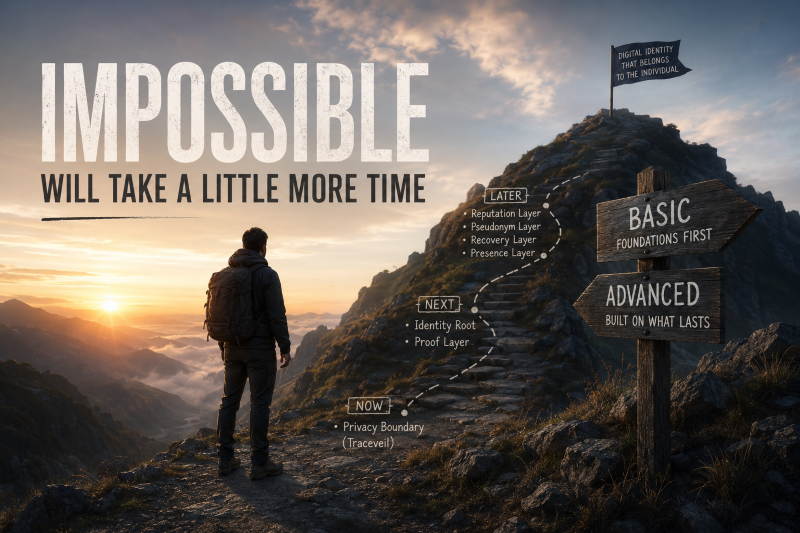
It has been two weeks since the first pieces of thought came together into the concept behind roamer.one. The first instinct was simple: build big. Build everything. Build the full personal digital sovereignty stack at once.
Identity. Privacy. Proof. Reputation. Pseudonyms. Recovery. Presence. All of it.
Then we got feedback, went deeper, and started asking harder questions.
What does each layer actually mean?
What technical solution could support it?
How difficult would it be to build?
How much adoption would it require?
Could it work independently, or would it depend on third-party capabilities?
That exercise changed the shape of the roadmap.
The foundation of the project is in a good place. The manifesto captures the essence of what we are dreaming about: digital identity that belongs to the individual. But a strong vision is not enough. The execution has to be credible.
Roamer does not start by replacing platform identity. That would be the wrong place to begin. It starts by giving individuals useful local tools for privacy, identity, and proof. Reputation and broader social trust come later, once there is something real for others to recognize. The design principle is simple: build first what is independently useful. If a tool requires a whole ecosystem before it becomes valuable, it belongs to a later phase. If it helps one person immediately, it belongs now.
Now: the basic components
Privacy boundary. This means protection against unwanted tracking, fingerprinting, leakage, and correlation. It comes first because it protects the individual immediately. It doesn't require platforms, institutions, or anyone else to adopt anything. Traceveil, the first piece of this layer, is already shipped and in active use, which is the proof of the principle rather than just a statement of it.
Next: root & proof
Identity root. A cryptographic identity controlled by the individual, and the foundation everything else builds on. The first thing I want us to build here is something I've wanted for a long time: a local-first digital wallet.
When I am online, I often feel an underlying anger and a quiet sense of dissolution of the self. So much of what represents me is owned, interpreted, monetized, and reused by companies I do not control. My accounts, my reputation, my browsing patterns, my profiles, my signals, my preferences, my history, and all of it gets pulled into an endless monetization loop.
There are good tools already, and I use some of them. DuckDuckGo. Physical security keys. Password managers. Privacy browsers. Wallets. Credential systems. Human-proof systems. But most existing systems solve one part of the problem in isolation.
Some solve wallets.
Some solve credentials.
Some solve privacy.
Some solve human proof.
Some solve authentication.
Some solve content verification.
Roamer should become an open-source personal sovereignty layer that connects identity, privacy, provenance, reputation, and recovery around the individual rather than around the institution, the platform, or the chain.
The first version doesn't need to do everything. It should start with a local, key-controlled or passkey-controlled identity root. Later, it can expand toward decentralized identifiers, export, and broader interoperability.
Proof layer. Verifiable claims, attestations, and selective disclosure. The first useful version should probably be authorship and content proof.
This one is dear to me. People should be able to prove that they created something, signed something, or had a piece of work at a specific moment in time, without handing their identity or creative history to a platform. A writer, builder, researcher, designer, or developer should be able to establish authorship that stays under their own control. It can become useful before reputation or any broader social-trust system exists.
Later: the advanced components
Some layers matter deeply but aren't realistic as starting points. They aren't abandoned. They are just not first.
Reputation depends on recognition, and recognition depends on other people, communities, or platforms choosing to accept the signal. That makes it ecosystem-dependent by nature, so it has to come after there's something real to recognize.
Pseudonyms - context-specific identities that can be persistent, reputable, and private - are central to the Roamer vision and could, in some form, be built independently. But they become far more meaningful once the identity root, proof layer, and privacy boundary already exist underneath them.
Recovery is essential . The ways to regain control of your identity without depending on one company. Bad recovery breaks sovereignty. Good recovery needs careful social, cryptographic, and operational design, and that design is easier to get right once the earlier layers are stable.
Presence - profiles, avatars, signatures, chosen public representations - still needs more research. It could become powerful, but only if it grows out of the identity and proof layers instead of turning into another profile system owned by someone else.
So the roadmap isn't a retreat from the larger vision. It's a sequencing decision: start with what can be useful to one person right now, build the foundations first, and let the advanced components arrive once there's enough real structure underneath them.
Impossible is not off the roadmap. It will just take a little more time.